A gyroscope is a mechanical or electronic device that utilizes the principle of angular momentum to maintain its orientation relative to the Earth's axis or resist changes in its orientation. A gyroscope typically consists of a spinning rotor, which provides angular momentum, and a set of gimbals or pivoted supports.
Every gyroscope is built around one or more axes, which serve as a foundational element in the device's construction. The spin axis is often aligned with the Z-axis, allowing the gyroscopic rotor to rotate freely, crucial for the device's operation. The housing or frame, along with bearings, provides structural support and protects the internal components.
While single-axis gyroscopes have just one primary axis of rotation, others, like three-axis gyroscopes, are designed to measure motion and orientation changes along all three spatial axes: X, Y and Z. The specific number and orientation of these axes can vary depending on the gyroscope's design and intended application.
Think of a single-axis gyroscope like a seesaw that only goes back and forth. It can only measure or respond to motion in one direction. On the other hand, a three-axis gyroscope is like a spinning top that you can move in any direction: forward and backward (X-axis), side to side (Y-axis) and even in a spinning motion like a top (Z-axis).
Now you may be wondering what any of this device has to do with Earth and its axis. The connection between the two can be found in the concept of gyroscopic stability. The planet acts as a colossal gyroscope because it rotates around its axis. This rotation gives Earth a property known as angular momentum, which means it wants to keep spinning in the same direction.
Gyroscopes, on the other hand, are devices designed to maintain their orientation in space by harnessing the principles of rotational movement (also referred to as rotational motion). They have a spinning rotor that resists changes in its axis.
When subjected to external forces, gyroscopes exhibit a behavior called precession, where their axis gradually changes direction rather than immediately tilting. (We'll take a closer look at this behavior in a bit.)
Gyroscopes essentially mimic Earth's stability in its rotation, which is why engineers and scientists can use these devices to achieve precise and steady motion or orientation in everything from navigation systems to spacecraft.
There's only one Earth — unless you live in a comic-book multiverse — but there are many types of gyroscopes, each tailored to specific applications:
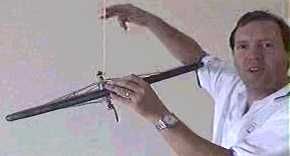
If you have ever played with toy gyroscopes, you know that they can perform all sorts of interesting tricks. They can balance on string or a finger and resist motion about the spin axis in very odd ways, but the most interesting effect is called gyroscopic precession. This is the gravity-defying part of a gyroscope. This 30-second video shows you the effects of precession, using a bicycle wheel as a gyro.
The most amazing section of the video is arguably the part where the gyroscopic bicycle wheel is able to hang in the air like this:
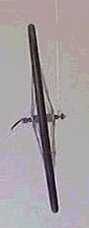
How can it do that?
This mysterious effect is precession.
In general, precession works like this: If you have a spinning gyroscope and try to change the orientation of its spin axis, the device will respond by changing its orientation along a different axis that is perpendicular (at right angles) to the axis of your applied force.
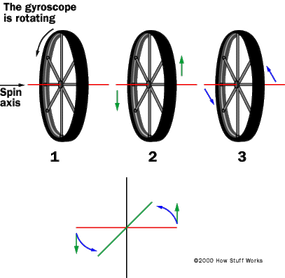
So why does precession happen?
Look at the illustration of three spinning wheels:
The effect of all this is that, once you spin a gyroscope, its axle wants to keep pointing in the same direction. If you mount the gyroscope in a set of gimbals so that it can continue pointing in the same direction, it will. This is the basis of the gyro-compass.
If you mount two gyroscopes with their axles at right angles to one another on a platform, and place the platform inside a set of gimbals, the platform will remain completely rigid as the gimbals rotate in any way they please. This is the basis of inertial navigation systems (INS).
In an INS, sensors on the gimbals' axles detect when the platform rotates. The INS uses those signals to understand the vehicle's rotations relative to the platform. If you add to the platform a set of three sensitive accelerometers, you can tell exactly where the vehicle is heading and how its motion is changing in all three directions.
With this information, an airplane's autopilot can keep the plane on course, and a rocket's guidance system can direct the rocket into a desired orbit.


